

About Course
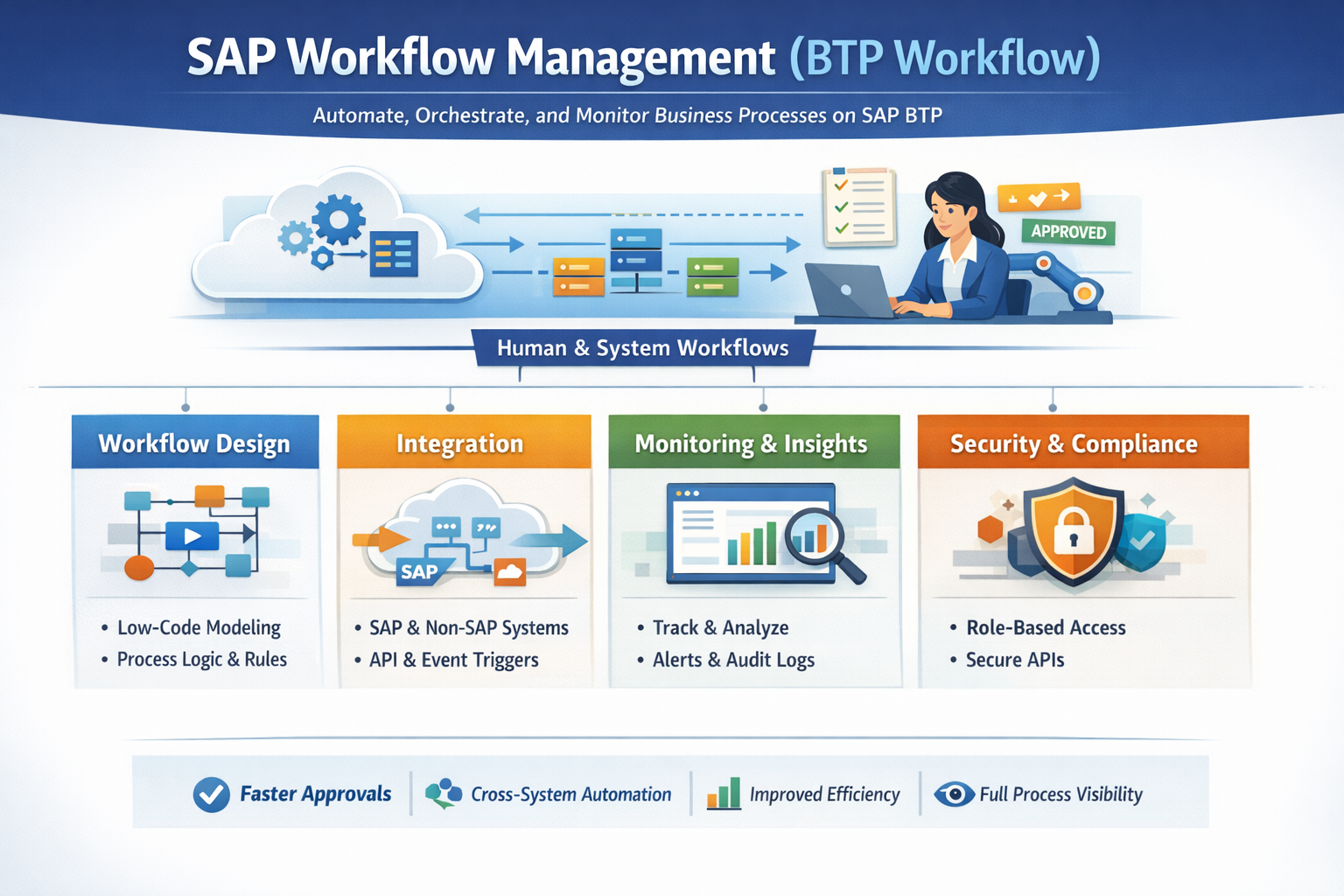
SAP Workflow Management is a cloud-native workflow automation service offered as part of SAP Business Technology Platform (SAP BTP). It enables organizations to design, execute, monitor, and optimize workflows that span across SAP and non-SAP applications, supporting both human-centric and system-driven processes.
In today’s digital enterprises, business processes are no longer confined to a single system. SAP Workflow Management addresses this challenge by providing a central orchestration layer that connects applications, users, and services—ensuring transparency, compliance, and efficiency.
🔹 Why SAP Workflow Management?
Traditional on-premise workflows were tightly coupled with SAP ERP systems and lacked flexibility, scalability, and cross-system integration. SAP Workflow Management modernizes workflow automation by offering:
- Cloud-first architecture
- Low-code & pro-code development
- Seamless SAP and non-SAP integration
- Real-time monitoring and analytics
- Future-ready extensibility
It replaces and extends classic SAP Business Workflow with a more agile, scalable, and API-driven approach.
🔹 Core Capabilities
1️⃣ Workflow Design & Modeling
SAP Workflow Management provides intuitive tools to model workflows using graphical editors in SAP Business Application Studio.
Key features:
- Start events (API-based or event-driven)
- User tasks (approvals, decisions)
- Service tasks (system actions)
- Script tasks (JavaScript logic)
- Conditional flows and branching
- Parallel and sequential processing
Workflow definitions are stored as version-controlled artifacts, enabling better lifecycle management.
2️⃣ Human-Centric Workflows
A major strength of SAP Workflow Management is its ability to manage human approvals and interactions.
Capabilities include:
- Task assignment to users, groups, or roles
- SAP Fiori My Inbox integration
- Priority, deadlines, and escalation handling
- Approval history and audit trail
- Mobile-friendly user experience
These features make it ideal for approval-heavy processes such as procurement, HR, finance, and compliance workflows.
3️⃣ System & Service Automation
Beyond human tasks, SAP Workflow Management can orchestrate automated system interactions:
- REST and OData service calls
- Integration with SAP S/4HANA APIs
- Execution of background services
- Automated validations and updates
- Error handling and retries
This allows organizations to combine human decisions with backend automation in a single workflow.
🔹 Integration Across the Enterprise
SAP Workflow Management acts as a process backbone connecting multiple systems:
SAP System Integration
- SAP S/4HANA (on-premise & cloud)
- SAP SuccessFactors
- SAP Ariba
- SAP Concur
- SAP Fieldglass
Non-SAP Integration
- Third-party applications via REST APIs
- Cloud services
- Legacy systems
- Custom applications
Using destinations and secure connectivity, workflows can be triggered or extended across the enterprise landscape.
🔹 Business Rules & Decision Automation
SAP Workflow Management integrates seamlessly with SAP Business Rules, allowing organizations to externalize decision logic.
Examples:
- Dynamic approval determination
- Threshold-based routing
- Country or department-specific logic
- Compliance-driven decisions
This separation of process flow and decision logic improves flexibility and reduces maintenance effort.
🔹 Event-Driven Workflows
Modern enterprises rely on events rather than batch-based triggers. SAP Workflow Management supports:
- API-triggered workflows
- Event-based workflows
- Integration with SAP Event Mesh
- Real-time response to business events
For example:
- Automatically trigger approval when a purchase order exceeds a limit
- Launch exception workflows when errors occur
- React instantly to changes in master or transactional data
🔹 Monitoring, Visibility & Control
Operational transparency is critical for business users and IT teams.
SAP Workflow Management provides:
- Centralized workflow monitoring dashboards
- Instance-level tracking
- Error diagnostics and logs
- Restart, cancel, or retry capabilities
- SLA and audit compliance support
This ensures business continuity and governance without manual intervention.
🔹 Security & Compliance
Security is deeply integrated into SAP Workflow Management:
- Role-based access control
- Secure API access using OAuth
- Workflow admin and runtime roles
- Audit logs for compliance
- Data isolation per subaccount
It complies with enterprise-grade security standards expected from SAP cloud solutions.
🔹 Typical Business Use Cases
SAP Workflow Management is widely used across industries for:
- Purchase requisition and PO approvals
- Invoice and payment approvals
- Leave and attendance approvals
- Master data governance
- Employee onboarding workflows
- Exception and error handling processes
- Compliance and audit workflows
These workflows reduce manual effort, improve turnaround time, and ensure policy adherence.
🔹 Benefits to Organizations
Implementing SAP Workflow Management delivers measurable business value:
- ⏱ Faster decision-making
- 📉 Reduced operational costs
- 🔍 End-to-end process visibility
- 🔁 Reusable and scalable workflows
- 🌍 Cross-system orchestration
- 📱 Improved user experience
- 🧩 Future-ready automation foundation
🔹 Who Should Learn SAP Workflow Management?
This solution is ideal for:
- SAP BTP Developers
- SAP Functional Consultants
- SAP Technical Consultants
- Workflow / BPM Architects
- Digital Transformation Teams
- Automation & Innovation Leads
🔹 SAP Workflow Management in the SAP Automation Stack
SAP Workflow Management works closely with:
- SAP Build Process Automation
- SAP Business Rules
- SAP Integration Suite
- SAP Build Apps
- SAP CAP applications
Together, these tools form a comprehensive intelligent automation ecosystem on SAP BTP.
🚀 Conclusion
SAP Workflow Management (BTP Workflow) is a strategic enabler for enterprise process automation. It empowers organizations to modernize workflows, integrate systems seamlessly, and deliver faster, more reliable business outcomes. As enterprises move toward cloud-first and event-driven architectures, SAP Workflow Management becomes a core building block for sustainable digital transformation.
📘 SAP Workflow Management (BTP Workflow) – Course Content
SAP Workflow Management is part of SAP Business Technology Platform (BTP) and is used to design, automate, and monitor business workflows across SAP and non-SAP systems.
🔹 Module 1: Introduction to SAP Workflow Management
- Evolution from SAP Classic Workflow to BTP Workflow
- Positioning within SAP BTP
- Workflow vs Business Rules vs Process Automation
- Use cases:
- Approval workflows
- Exception handling
- Human + system workflows
- Licensing & service plans overview
🔹 Module 2: SAP BTP Fundamentals (Required Basics)
- SAP BTP global account, subaccount, environments
- Cloud Foundry vs Kyma (overview)
- Entitlements & service instances
- Destinations & connectivity basics
🔹 Module 3: Workflow Management Architecture
- Workflow service components
- Runtime vs Design time
- Workflow APIs
- Integration with:
- SAP S/4HANA
- SAP SuccessFactors
- SAP Ariba
- Non-SAP systems
🔹 Module 4: Workflow Development Tools
- SAP Business Application Studio (BAS)
- Workflow Editor
- Project structure
- Deployment lifecycle
- Transport concepts (Dev → QA → Prod)
🔹 Module 5: Workflow Modeling Basics
- Workflow definitions
- Steps:
- Start events
- User tasks
- Service tasks
- Script tasks
- Context data & JSON structure
- Conditions & branching
🔹 Module 6: User Tasks & UI Integration
- Inbox (My Inbox app)
- Task UI concepts
- UI technologies:
- SAPUI5
- Fiori Elements
- Task outcomes & decisions
- Priority, deadlines & escalations
🔹 Module 7: Service Tasks & Automation
- Calling REST APIs
- OData service integration
- Using destinations
- Script task using JavaScript
- Error handling & retries
🔹 Module 8: Business Rules Integration
- Introduction to SAP Business Rules
- Rule service concepts
- Decision tables
- Linking rules to workflows
- Dynamic approval logic
🔹 Module 9: Events & Triggers
- Workflow triggers:
- API-based
- Event-based
- SAP Event Mesh (intro)
- Triggering workflows from S/4HANA
- Custom event creation
🔹 Module 10: Workflow Monitoring & Operations
- Monitor Workflow app
- Instance tracking
- Error analysis
- Restart & cancel workflows
- Audit & logs
🔹 Module 11: Security & Authorization
- Role collections
- User access control
- Workflow admin roles
- Secure API access
- OAuth concepts (basic)
🔹 Module 12: Advanced Workflow Concepts
- Parallel approvals
- Sub-workflows
- Reusable workflow templates
- Versioning strategies
- Performance considerations
🔹 Module 13: Integration Scenarios
- Workflow + SAP S/4HANA
- Workflow + SAP CAP
- Workflow + SAP Build Apps
- Workflow + SAP Integration Suite (CPI)
🔹 Module 14: Real-Time Business Scenarios
- Purchase order approval
- Leave request workflow
- Invoice approval
- Master data approval
- Exception handling workflows
🔹 Module 15: Best Practices & Project Guidelines
- Naming conventions
- Workflow design standards
- Error handling strategy
- Scalability & reusability
- Production deployment checklist
🎯 Who Should Learn This Course
- SAP Functional Consultants
- SAP Technical Consultants
- SAP BTP Developers
- Workflow / BPM Architects
- S/4HANA Consultants
- Automation & Digital Transformation teams
🚀 Career Outcomes
- SAP BTP Workflow Developer
- SAP Process Automation Consultant
- SAP Technical Architect
- SAP Digital Transformation Specialist